REVIEW · MONREALE
Monreale: Guided tour of Cathedral, Monastery and Mosaics
Book on GetYourGuide →Operated by Italygonia Travel T.O. · Bookable on GetYourGuide
Golden mosaics in a single hour. Monreale is just 5 km from Palermo, and this guided stop is built around one big payoff: the UNESCO-listed cathedral with its legendary gold mosaics. I also like how the tour frames what you’re seeing in plain context, so the cathedral feels less like a photo and more like a story.
I’m equally drawn to the visit to the 12th-century Benedictine monastery and cloisters, which keeps the experience from feeling like only a quick cathedral sprint. One thing to watch: cathedral and cloister tickets aren’t included, so you’ll want to plan for that extra step before or during your visit.
In This Review
- Key things I’d plan around
- Monreale Cathedral: what the gold mosaics really mean
- The doors outside are not an afterthought
- The Norman story you’ll hear from the guide
- Benedictine monastery and cloisters: a calmer half of the visit
- The views from Mount Caputo and the Conca d’Oro valley
- Timing, duration, and what fits in one hour
- Price and value: when $344.39 per group makes sense
- Where it starts and where you end
- Cancellation, language options, and who this tour suits
- Should you book this Monreale guided tour?
- FAQ
- How long is the Monreale guided tour?
- Where does the tour start and end?
- Is hotel pickup or drop-off included?
- What’s included in the price?
- Are cathedral and cloister tickets included?
- What languages are offered for the live guide?
- Is this a private group tour?
- What sights do we visit during the tour?
- When can I take the tour?
- What’s the cancellation policy?
Key things I’d plan around
- UNESCO World Heritage focus (declared in 2012): You’re seeing the site at the heart of Monreale’s fame.
- Norman-era mix in one building: You’ll spot northern European architecture paired with Romanesque and Arabic art.
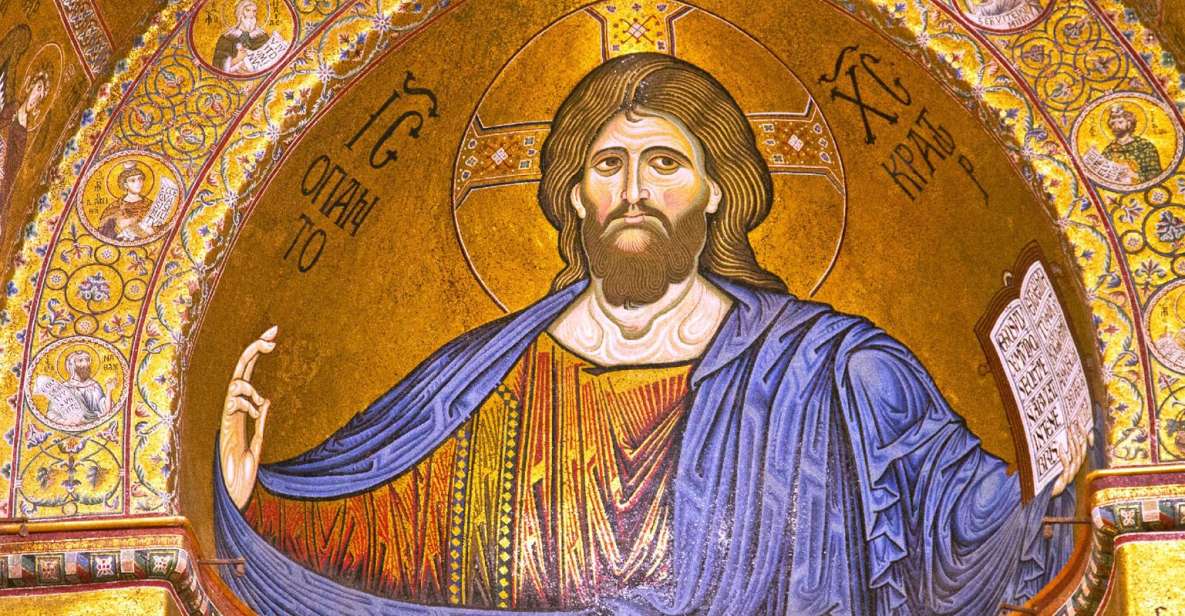
- Christ Pantocrator in the apse: The mosaics culminate in this central image.
- Bronze doors with named artists: Bonanno da Pisa and Barisano di Trani both get credit for major entrance work.
- Monastery + cloisters right next to the cathedral: Short walk, big change of mood.
- Viewpoint over the Conca d’Oro valley: You get the orange-and-citrus “golden basin” panorama at the end.
Monreale Cathedral: what the gold mosaics really mean
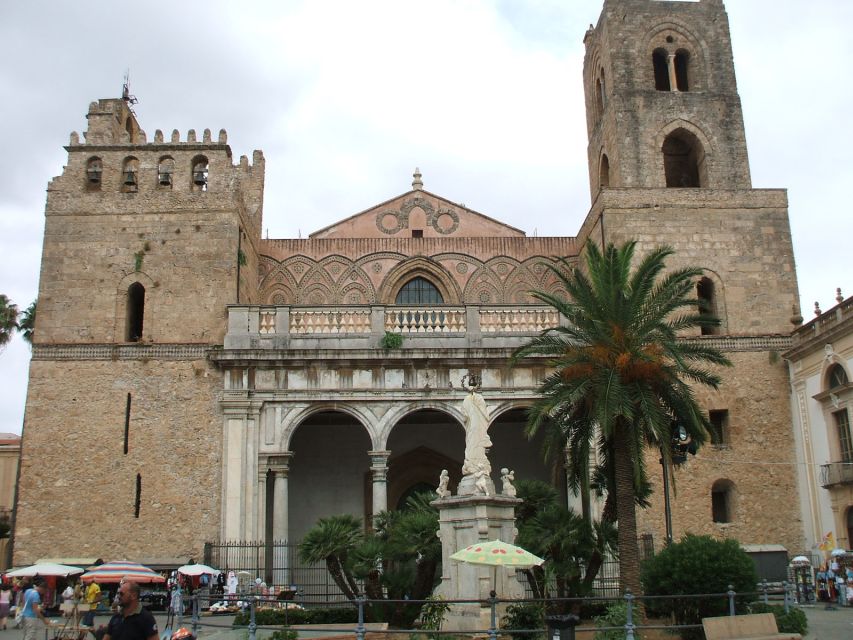
Monreale is perched on Mount Caputo at about 310 meters above sea level, which helps explain why the cathedral looks like it owns the hill. From the start, you’ll be grounded in place. The tour begins at Piazza Guglielmo II suare at the cathedral entrance, so you immediately step into the center of town’s most important landmark.
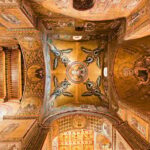
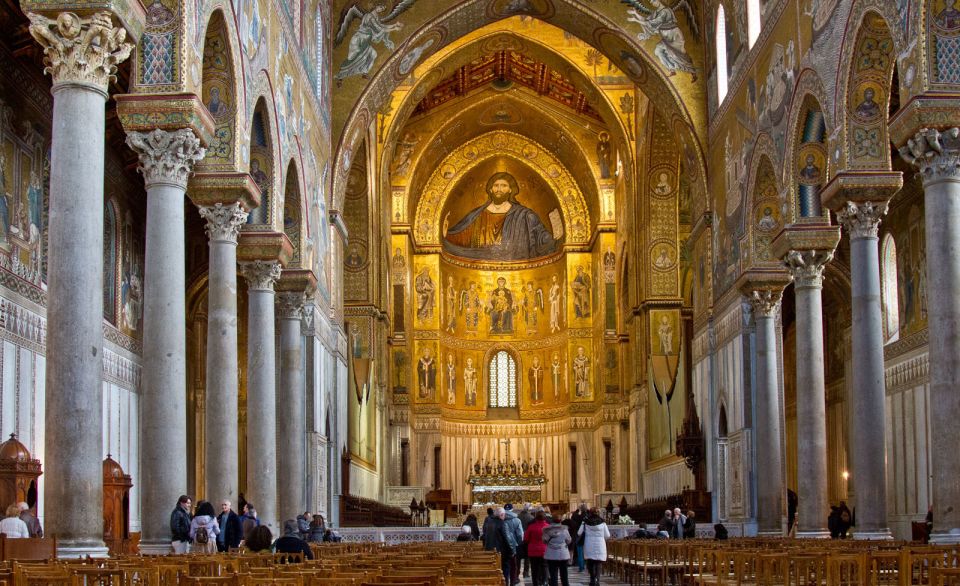
The cathedral itself is the reason people come. It’s a 12th-century masterpiece where styles don’t politely stay in their lanes. Instead, you see northern European architecture, Romanesque art, and Arabic art linked together in the same place. If you’ve ever felt that Sicily can be confusing in a good way, this is the visual version of that idea.
Inside, the mosaics are lit in a way that makes them feel almost architectural—not just decorative. The tour leads you to the mosaics’ high point: the Christ Pantocrator in the apsidal basin. This matters because it turns the cathedral from “wow, shiny gold” into “wow, message.” The ceiling and walls aren’t random. They’re guiding your eyes toward the central figure.
You can also read our reviews of more tours and experiences in Monreale.
The doors outside are not an afterthought
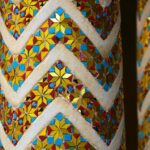
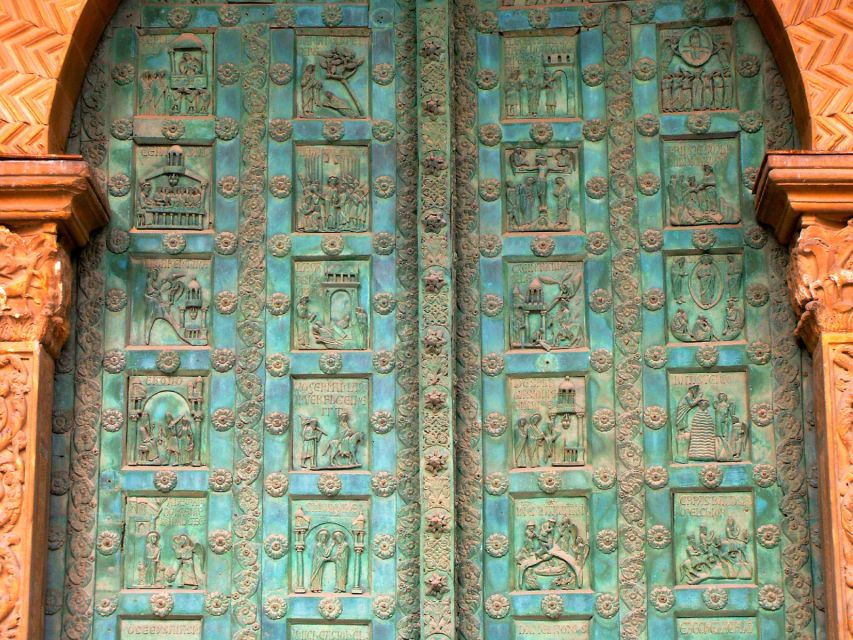
A nice touch of this visit is that it doesn’t treat the outside like a quick photo pause. The cathedral’s exterior is richly decorated, including two bronze doors—and the tour calls out the artists.
- The first door is credited to Bonanno da Pisa.
- The second is by Barisano di Trani, who also sculpted doors of the cathedrals of Ravello and Trani.
That kind of detail helps you look smarter while you’re standing there. When you know a name, you notice craftsmanship faster. You also start spotting how Monreale connects to a wider set of Mediterranean artistic movements—Sicily wasn’t isolated; it was a crossroads.
The Norman story you’ll hear from the guide
This is where the guided part earns its keep. In excellent tours, the guide doesn’t just list facts. A great example from the experience is Margherita, praised for explaining how the Normans fit into Palermo’s history. That framing changes how the cathedral lands for you.
If you’re visiting Palermo first (common), you’ll likely notice how Monreale feels related rather than separate. The Normans are a thread tying the region’s story together, and the tour makes that thread easier to follow without turning it into a textbook. You’ll walk in with questions, and the guide gives you answers you can actually use while you look.
Benedictine monastery and cloisters: a calmer half of the visit
After the cathedral, the tour shifts tone. You’ll walk to the ancient Benedictine monastery and cloister, which flank the cathedral. That layout is part of the charm: you’re not traveling across town to see something different. You’re seeing a different rhythm of the same religious complex.
The monastery and cloisters matter because they show the building as a working space, not only a monument. In a one-hour tour, you get just enough time to feel the contrast between grand display (mosaics) and quieter structure (cloister and monastery). It’s the change that helps the cathedral experience stick in your memory.
The cloisters also help you slow down. You can take in details at a human pace. And because you’re already oriented from the cathedral, the cloister area feels like it completes the picture instead of competing with it.
The views from Mount Caputo and the Conca d’Oro valley
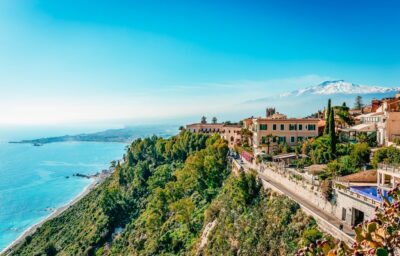
This tour includes a scenic payoff: a viewpoint overlooking the Conca d’Oro valley. That’s not just a pretty backdrop. It’s an explanation of why people built big religious landmarks where they did.
You’ll see the valley described as a golden basin of orange and citrus groves. Even if you don’t see every grove like a postcard, you get the idea: the landscape supports life, trade, and settlement—and the city’s monument sits above it like a watchtower.
At 310 meters, the viewpoint makes sense. Monreale isn’t far from Palermo, but it feels set slightly apart. This is one of those moments where you stop thinking only about architecture and start thinking about geography.
Timing, duration, and what fits in one hour
The guided tour runs for 1 hour, with starting times you can check when you book. That short window is both a strength and a limitation.
Why it works:
You’ll cover the big-ticket items—cathedral mosaics, monastery/cloister, and the viewpoint—without getting stuck in a long schedule. It’s ideal if you’re also planning Palermo the same day.
Why it may not work:
A one-hour visit means you’re unlikely to linger slowly in every corner. If you love taking notes, sketching, or reading every panel, you may want extra time on your own after the guided portion.
Group size is described as a private group with up to 25 people. That usually means the guide can keep things coherent, but it’s still not a personal, one-on-one lecture.
Price and value: when $344.39 per group makes sense
This experience costs $344.39 per group (up to 25 people) and includes a licensed guide. Tickets for the cathedral and cloister are not included, so your total spend will be a little higher once you factor those in.
Is it good value? For me, the answer is yes if your goal is to get the meaning out of the main sights fast. You’re paying for an organized look at:
- UNESCO cathedral mosaics and their central image (Christ Pantocrator)
- the named bronze door artists
- the monastery and cloister visit in context
- the valley viewpoint that ties the monuments to the landscape
If you’re the kind of visitor who enjoys details like artist names and how styles link together (northern European + Romanesque + Arabic), the guide saves you effort and helps you notice more than you would alone. If you just want a quiet walk and zero narration, you might find you don’t need a guide for this particular hour.
Where it starts and where you end
You meet at Piazza Guglielmo II suare at the Monreale cathedral entrance. The tour ends back at the same meeting point, so you don’t have to worry about a strange drop-off location.
No hotel pickup or drop-off is included. That’s normal for town-center walking tours, but it’s worth planning how you’ll get there from Palermo (or wherever you’re staying).
Cancellation, language options, and who this tour suits
You’ve got free cancellation up to 24 hours in advance for a full refund, plus a reserve now & pay later option. That reduces the stress if your day in Palermo depends on weather or timing.
The guide language options are Spanish, English, French, and Italian. If you prefer English, you’ll want to choose the time that offers your language.
Best fit for:
- People visiting Monreale as part of a Palermo day
- Anyone who likes guided context, especially the Norman connection and how styles mix
- Visitors who want the highlights without dragging a whole day out of your schedule
Less ideal for:
- If you already plan to spend several hours inside and want maximum free time
- If you strongly dislike ticketing logistics, since cathedral and cloister tickets aren’t bundled in the price
Should you book this Monreale guided tour?
Book it if you want the most important Monreale sights explained in a tight schedule. In particular, this tour makes sense if you care about the cathedral’s big ideas—how the styles connect, why the mosaics climax at the Christ Pantocrator, and how a guide like Margherita can connect the dots between Monreale and the wider Palermo-Norman story.
Skip (or consider adding solo time) if your plan is to wander at your own pace for hours. With only 1 hour, you’ll get the highlights, but you won’t get a slow, deep museum-style experience.
FAQ
How long is the Monreale guided tour?
It’s listed as a 1 hour guided tour.
Where does the tour start and end?
The meeting point is Piazza Guglielmo II suare at the Monreale cathedral entrance, and the tour ends back at the same meeting point.
Is hotel pickup or drop-off included?
No. Hotel pickup and drop-off are not included.
What’s included in the price?
The tour includes a licensed guide.
Are cathedral and cloister tickets included?
No. Cathedral and cloister ticket(s) are not included.
What languages are offered for the live guide?
The live guide is available in Spanish, English, French, and Italian.
Is this a private group tour?
Yes. It’s described as a private group and your group can be up to 25 people.
What sights do we visit during the tour?
You’ll start at the cathedral, then visit the 12th-century Benedictine monastery and cloisters, and you’ll also see a viewpoint over the Conca d’Oro valley.
When can I take the tour?
The listing says starting times vary, so you’ll need to check availability for the specific times offered.
What’s the cancellation policy?
You can cancel up to 24 hours in advance for a full refund.