REVIEW · SICILY
Private Tour of Syracuse in 6 hours with Enrica De Melio
Book on Viator →Operated by Viaggio a Sud-Est · Bookable on Viator
Syracuse feels like two cities stitched together. One foot in the ancient world, the other in Ortigia’s everyday charm, all guided by Enrica De Melio. You get a private half-day with a real archaeologist, plus a walk that strings together the key sights without you playing guess-the-history.
What I like most is the way Enrica makes the sites make sense fast, from the famous acoustics story of the Ear of Dionysius to the bigger timeline in the Neapolis park. I also love that the tour is built for a relaxed pace: it’s long enough to enjoy the details, not just speed through photos.
The main thing to consider is that you’ll still need to budget for entrance tickets at the Neapolis Archaeological Area (listed as €17 per person, with free entry under 18). It’s a small extra step, but it can catch you if you’re expecting everything to be included.
In This Review
- Key Highlights You’ll Care About
- Why This Private Syracuse + Ortigia Tour Works
- The Neapolis Archaeological Park: Ear of Dionysius and the Roman Amphitheater
- Ortigia on Foot: Temple of Apollo, Duomo Square, and Arethusa’s Spring
- What You’re Really Paying For: Enrica De Melio’s Style and Expertise
- Timing, Meeting Point, and How to Plan Your Day
- Value for Money: Private Guide + Ticket Reality
- Who This Tour Is Best For
- Should You Book This Syracuse + Ortigia Private Tour?
- FAQ
- FAQ
- How long is the private tour of Syracuse and Ortigia?
- Is this a private tour?
- Where does the tour start and end?
- What are the main sites you’ll visit?
- Are entrance tickets included?
- Do you include lunch?
- What’s included in the tour price?
- Is transportation provided during the tour?
- What kind of walking level should I expect?
- What if I miss the tour due to cruise timing?
- What is the cancellation policy?
Key Highlights You’ll Care About
- PhD archaeologist guide (Enrica De Melio) who explains ruins in order, not as random facts
- Neapolis Archaeological Park walk featuring the Ear of Dionysius and major Greek-to-Roman landmarks
- Ortigia by foot with Temple of Apollo, Duomo Square, and Arethusa’s Spring
- Private, just your group tour that supports questions and pacing
- Mobile ticket for an easier check-in
- Moderate walking over uneven outdoor terrain, best with smart shoes
Why This Private Syracuse + Ortigia Tour Works
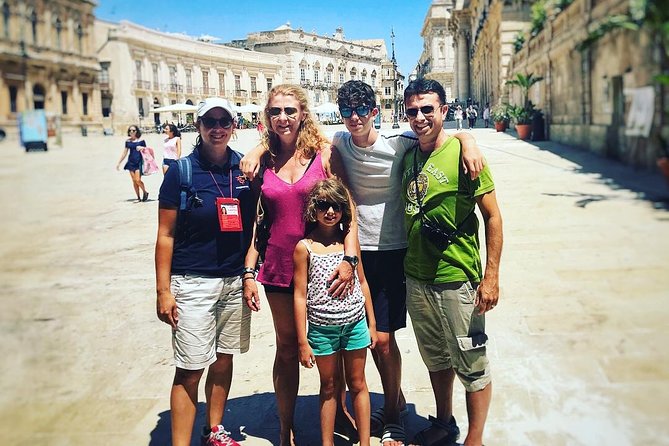
Syracuse can overwhelm you if you arrive with only a guidebook and a map. The city is packed with layers—Greek origins, Roman remodeling, then the living Ortigia island that still feels like a place people actually go.
This tour is interesting because it’s structured like a story. In the Neapolis Archaeological Park, you walk through major stops in chronological order, so you’re not just seeing what’s famous—you’re understanding how the city evolved. Then the pace shifts to Ortigia, where the landmarks aren’t only ruins. They’re part of daily street life, with squares, churches, springs, and temple sites you can stand right beside.
If you’re traveling with someone who learns better by walking and talking (instead of reading panels), this is a great fit. The guide’s approach—clear, connected, and very “tell me what I’m looking at”—makes the time fly in the best way.
You can also read our reviews of more private tours in Sicily
The Neapolis Archaeological Park: Ear of Dionysius and the Roman Amphitheater
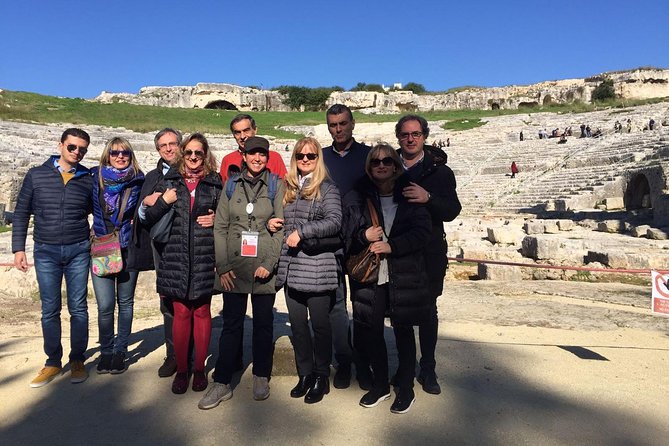
Neapolis is the big stage for ancient Syracuse. Plan for a focused, outdoors walking portion of about 1 hour 30 minutes. The walking circuit is designed around major sites that cover a wide span of time, and that matters. You’ll see how the same hillside becomes a theater, an altar area, and later Roman entertainment space.
Here’s what stands out on the walk:
Quarry of Paradise (Latomie) and the Ear of Dionysius
- This is where the famous acoustics legend comes from: the Ear of Dionysius is tied to the Quarry of Paradise rock-cut spaces. You’re looking at engineered stone work where the setting is half natural, half crafted by people.
- The guide’s chronological storytelling helps a lot here. Instead of the usual “legend first” approach, you get context for how this kind of quarry space fit into the broader ancient world.
Cave of the Rope-makers
- Nearby rock-cut areas like the Cave of the Rope-makers give the park a more workaday feel. It’s a reminder that ancient monumental projects weren’t just about statues and ceremonies; they involved labor and practical use of space.
Greek Theatre
- The Greek Theatre is the moment where you’ll feel the scale. Even if you’ve seen other Greek theaters, this one lands differently because of the surrounding quarry and the way the park is laid out.
- The guide’s framing helps you notice details you might otherwise miss, like how the theater relates to the broader layout of Neapolis.
Altar of Hiero II
- The Altar of Hiero II is described as the largest in the world, and even if you don’t measure that claim in your head, it’s clearly built for serious ceremonies. It’s one of those stops where standing still beats taking photos.
Roman Amphitheater
- The Roman Amphitheater shifts the tone. The architecture tells you that later rulers didn’t just keep the old city; they repurposed and reshaped it.
- This ending stop makes the whole park loop feel complete: you can see the Greek foundation, then the Roman reinterpretation.
A drawback to flag: the Neapolis area requires a separate entrance ticket (listed as €17 per person; free under 18). That’s not a dealbreaker, but it does mean you should arrive ready to pay for entry if you want the full experience.
Ortigia on Foot: Temple of Apollo, Duomo Square, and Arethusa’s Spring
After the ancient park, the tour shifts to Ortigia, the small island connected to Syracuse by bridges. This part is about 1 hour 30 minutes and feels more like walking through a living postcard—without losing the historical thread.
You’ll cover the main sights on foot, which is perfect here. Ortigia is made for short pauses: you’ll stop in squares, look toward temple foundations, and then move on before you get bored.
Key stops you can expect:
Temple of Apollo (VI century BC)
- You’ll see the Temple of Apollo, dating to the 6th century BC. Seeing a temple site in an urban setting changes your perspective. It’s not “an isolated ruin” on purpose—it’s built into the city’s long memory.
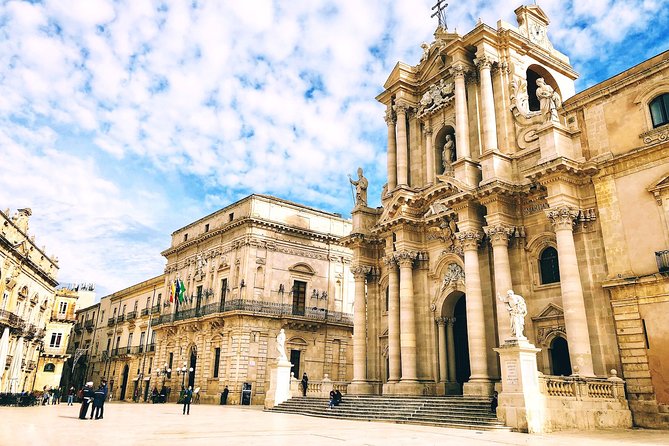
Duomo Square and the Cathedral/Temple of Athena
- The walk leads you to Duomo Square, surrounded by baroque palaces.
- The highlight in this area is the Cathedral/Temple of Athena. This is where Syracuse gets especially layered: one sacred site standing on top of another. It’s the kind of place where the guide’s explanation makes your eyes move differently.
Arethusa’s Spring
- The tour ends this portion at Arethusa’s Spring, where the city’s mythology and everyday life overlap.
- The spring is famous for a reason: it’s one of those spots that feels both historic and real, not staged.
Ticket note: the tour data says the Ortigia stop has an admission ticket included, but it also lists the Cathedral of Syracuse entrance ticket (€2 per person) as not included. In practice, this means you should expect a small extra cost if you want to go inside the cathedral rather than view it from the square.
What You’re Really Paying For: Enrica De Melio’s Style and Expertise
You’re paying for more than access to sites. The value here is the quality of explanation and the way the tour is paced for learning.
Enrica De Melio is described as a PhD archaeologist guide, and it shows in how the experience feels. The goal isn’t to overwhelm you with dates. The guide’s approach is built around making connections—how each place fits into the city’s story, and what you should look for when you’re standing there.
This matters because ancient places can feel repetitive if no one helps you “see” them. With the right guide, the Neapolis park stops aren’t just impressive. They become readable. You learn how to interpret the space: where ceremony happened, where people gathered, and how the Roman era adapted older forms.
Also worth noting from past experiences: Enrica is known for being thoughtful about the visit in terms of personal needs. If you have physical limitations or specific concerns about walking surfaces, it’s smart to mention them ahead of time. A private guide can adjust pacing far more than a fixed-group tour.
Timing, Meeting Point, and How to Plan Your Day
This tour starts at 9:30 am at the Neapolis Archaeological Park, Via Luigi Bernabò Brea 14, Siracusa SR, Italy. It ends at Arethusa’s Spring, Largo Aretusa, 96100 Siracusa SR.
Plan on a total duration of about 5 to 6 hours including the guided walking. That time window is right for a half-day when you’re still going to want energy for lunch and an evening walk somewhere else in Ortigia.
Two practical things to know:
- Transportation isn’t included. You’re responsible for getting yourself to the start point and for handling any movement beyond the guided walk.
- The tour is private, with a group size up to 8. In other words, it won’t turn into a noisy herd. It stays conversational.
Dress code is smart casual. For footwear, assume you’ll be walking on uneven outdoor surfaces in an ancient park. Bring comfortable shoes—you’ll thank yourself.



Value for Money: Private Guide + Ticket Reality
At $361.11 per group (up to 8), the headline price looks high until you spread it across your group. The real value depends on two things:
- You’re buying expert time, not just tickets. A PhD archaeologist guide for about half a day is where the money goes.
- You still pay site admissions separately for at least the Neapolis Archaeological Area.
Here’s what that means for your budget:
- Neapolis Archaeological Area entrance is listed at €17 per person (free under 18).
- Cathedral of Syracuse entrance is listed at €2 per person (not included).
So the best way to judge value is like this: if you’re traveling with 3 to 8 people, you can turn this into a cost-effective way to see the big Syracuse highlights without sacrificing quality. If you’re traveling as a couple or solo, you’ll be paying more per person for privacy, but you still get strong value if you prefer guided learning over wandering.
Also, the tour is described as booked about 56 days in advance on average, which usually means people plan it as a “must-do” once they’re committed to Syracuse. If your dates are fixed, booking ahead is smart.
Who This Tour Is Best For
This is a great match if you want:
- A first-time Syracuse introduction that doesn’t miss the core ancient sites
- A guide who can explain what you’re seeing in plain, connected language
- A private pace that lets you ask questions and pause for photos
It may not be your best fit if:
- You hate walking for stretches of time outdoors, because the Neapolis portion is an active archaeological park visit
- You prefer free-choice touring where you spend lots of time lingering without structure
- You want all tickets included with no extra fees (ticket admissions are listed as not included for key sites)
Should You Book This Syracuse + Ortigia Private Tour?
If you care about understanding ancient Syracuse instead of just collecting landmarks, I’d book this. The combination of Neapolis Archaeological Park in chronological order plus the Ortigia walk keeps your day coherent. And with Enrica De Melio as your private guide, you’re likely to come away with a real sense of how the city changed over time.
Book it especially if:
- You’re a history-minded traveler who likes guided context
- You’re traveling as a small group and want the private experience to pay off
- You want a morning start that sets you up for the rest of the day
Hold off if:
- You’re budget-sensitive about entrance fees and prefer tours where everything is packaged
- You have very limited ability to walk outdoors for a few hours
FAQ
FAQ
How long is the private tour of Syracuse and Ortigia?
The duration is about 5 to 6 hours (approximately), starting at 9:30 am.
Is this a private tour?
Yes. It’s a private experience, and only your group participates (up to 8 people).
Where does the tour start and end?
It starts at Neapolis Archaeological Park, Via Luigi Bernabò Brea 14, 96100 Siracusa SR and ends at Arethusa Spring, Largo Aretusa, 96100 Siracusa.
What are the main sites you’ll visit?
You’ll visit Parco Archeologico della Neapolis (including the Ear of Dionysius and other key landmarks) and then Ortigia (including sights like Temple of Apollo, Duomo Square, and Arethusa’s Spring).
Are entrance tickets included?
Neapolis Archaeological Area entrance tickets are not included (listed as €17 per person, free under 18). Cathedral of Syracuse entrance is also not included (listed as €2 per person).
Do you include lunch?
No. Lunch is not included.
What’s included in the tour price?
The tour includes a PhD archaeologist guide and a mobile ticket.
Is transportation provided during the tour?
No. Transportation to/from attractions is not included.
What kind of walking level should I expect?
The tour asks for moderate physical fitness. It’s guided walking across archaeological and historic areas.
What if I miss the tour due to cruise timing?
Refunds will not be issued if the tour is missed due to late or non-arrival of a cruise ship.
What is the cancellation policy?
You can cancel for a full refund if you cancel at least 24 hours in advance. The service may be canceled due to poor weather, with an option for a different date or a full refund.