REVIEW · SICILY
Syracuse: tour of the Neapolis Archaeological Park (max 6 guests)
Book on Viator →Operated by Viaggio a Sud-Est · Bookable on Viator
Syracuse’s ancient ruins make sense fast with the right guide. This private Neapolis Archaeological Park tour (max 6 guests) is led by Dr. Enrica De Melio, PhD, and you’ll get clear explanations for the Ear of Dionysius, the Teatro Greco, the Ara di Ierone, and the Roman amphitheater—plus time to ask questions. I love the small-group feel and I love how Enrica uses pictures and diagrams to help you picture what you’re standing in. One thing to plan for: the park entrance fee is extra (€14 per person), so the advertised tour price isn’t the full cost.
The pace is built for a focused visit, not a marathon. The tour is about 1 hour 30 minutes, and it’s designed for people with moderate physical fitness, so you’ll be walking the site at a comfortable rhythm. If you want to linger for a lot longer, you might find this too short—Neapolis rewards extra time, especially if you’re the type who reads inscriptions and scans every corner.
In This Review
- Quick hits
- A private Neapolis walk with Dr. Enrica De Melio
- Price and tickets: what the €14 entrance fee changes
- Ear of Dionysius: the cave that turns sound into a story
- Teatro Greco: third largest Greek theater and a guide that points out the details
- Ara di Ierone: Zeus at a III century BC altar
- Anfiteatro Romano di Siracusa: the fourth largest amphitheater
- A 1.5-hour loop vs. a longer Neapolis stay
- Small group comfort: how you’ll experience the tour day
- Who should book this Neapolis private tour
- Should you book the Neapolis private tour with Enrica?
- FAQ
- How long is the Syracuse Neapolis Archaeological Park private tour?
- Is the tour available in English?
- What is included in the price?
- Do I need to pay an entrance fee?
- What group size should I expect?
- What happens if the weather is bad or I need to cancel?
Quick hits
- PhD archaeologist guide: Dr. Enrica De Melio, PhD leads the walk in English.
- Max 6 guests: a private-style group that makes questions feel easy, not awkward.
- Ear of Dionysius stop first: you get a full 30 minutes in the cave (admission not included).
- Major theater and altar highlights: Teatro Greco (third largest Greek theater) and Ara di Ierone (III century BC, dedicated to Zeus).
- Roman amphitheater in the mix: Anfiteatro Romano di Siracusa (fourth largest amphitheater) rounds out the story.
- Ticket is mobile: you’ll use a mobile ticket, and confirmation comes at booking.
A private Neapolis walk with Dr. Enrica De Melio
This is the kind of tour that works because it stays human-sized. With a maximum of 6 travelers, you’re not stuck following a moving herd. You can actually ask, pause, and re-orient yourself as the site shifts from myth to history to architecture. And you’ll notice the difference when the guide can slow down for your questions instead of racing to the next group.
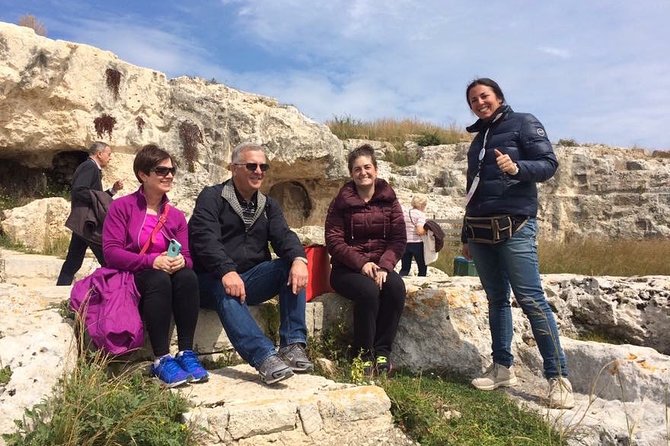
Dr. Enrica De Melio, PhD, is the reason this feels like more than a checklist. She’s an archaeologist, so the explanation isn’t just dates and names. She helps you connect what you see—stonework, spaces, and sightlines—to what people were doing there in different eras. One review highlighted how she used pictures and diagrams to show how areas once looked. That’s exactly what you want in a place like Neapolis, where so much is weathered, partial, or hard to visualize.
The tour is offered in English. The route also includes a cave, a large open-air theater, and outdoor monuments, so you’ll spend a fair amount of time switching modes: listening, looking, and then looking again with new context.
You can also read our reviews of more tours and experiences in Sicily.


Price and tickets: what the €14 entrance fee changes
The price is $249.68 per person for about 1 hour 30 minutes. That sounds high—until you compare it to what you’re actually buying: a private guiding experience from a PhD archaeologist, delivered to a small group (max 6) rather than a large bus group.
Here’s the catch you should plan around: entrance fees are not included. You’ll need the Biglietto d’ingresso all’Area Monumentale della Neapolis di Siracusa for €14.00 per person. Since each stop lists admission as not included, assume you’ll be paying that entrance ticket on top of the tour price.
So how do you judge value?
- If you want a guided explanation that helps you read the site instead of just walking past it, the price often feels fair.
- If you’re perfectly happy doing this self-guided with a phone map and no deep context, you may feel the cost is steep for just 90 minutes.
In short: this is a pay-for-meaning tour, not a pay-for-standing-here tour.
Ear of Dionysius: the cave that turns sound into a story
Stop 1 is the Ear of Dionysius, and you get 30 minutes here. The schedule matters because this is the kind of place where time helps. A cave isn’t just a “see it” moment. The whole point of the Ear is that it’s a cave unique in the world, and that uniqueness changes how you experience it.
What you’ll likely appreciate most is the explanation tying the cave to the broader Syracuse story—ancient power, legend, and architecture built for dramatic effect. The Ear of Dionysius is famous enough that you may know the basics already, but with a guide you’ll pick up the behind-the-scenes thinking: why a space like this would exist, and how the surrounding monumental area fits into the bigger picture of Neapolis.
Practical note: this is a cave stop, so don’t expect the same open, breezy feeling as the theaters. Wear shoes that work on uneven ground, and keep your phone light useful but not blinding.
Admission isn’t included here, so have your entrance ticket ready before you start.
Teatro Greco: third largest Greek theater and a guide that points out the details
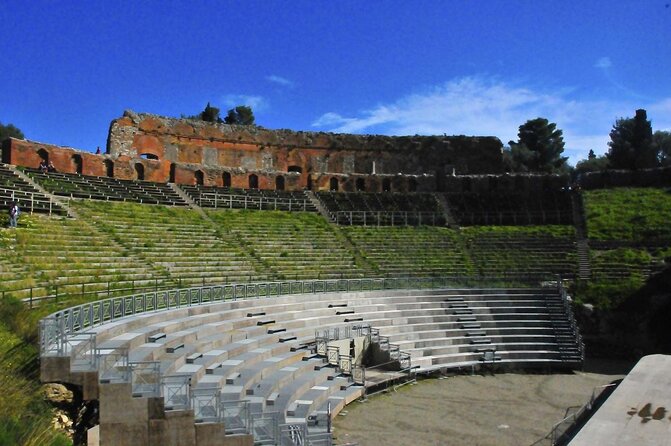
Next comes the Teatro Greco for 15 minutes. This is described as the third largest Greek theater in the world, and that’s one of those stats that’s helpful, not just trivia. Big theaters can feel generic until someone shows you how they’re used—how people viewed performances, how seating created different experiences, and how the design helped turn an audience into part of the show.
This is also the stop where a guide really earns their fee. The site can be visually stunning, but the small stuff is easy to miss—especially inscriptions or marks that aren’t obvious from a distance. One of the notes you’ll feel in practice is that some details get hard to make out due to age and wear. A strong guide will point at things you would otherwise glide past.
If you’re the type who likes to understand what you’re looking at, this is a great moment to lean in. Ask about how a Greek theater differs from what you might picture from Rome, and don’t be shy about asking what to focus on as you move around the structure.
Ara di Ierone: Zeus at a III century BC altar
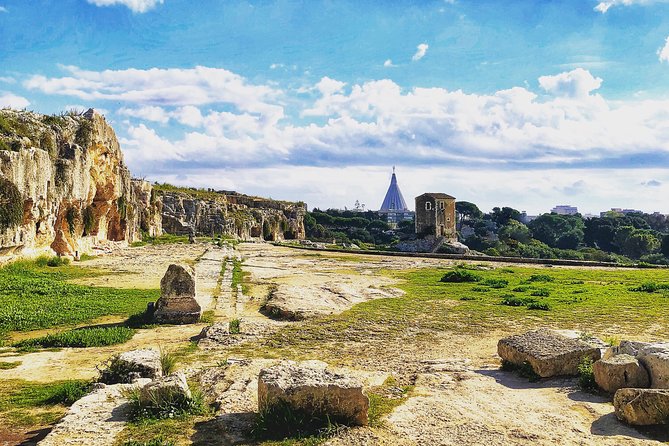
Stop 3 is Ara di Ierone, a Greek altar dating to the III century BC, dedicated to Zeus. You only get 5 minutes here, and that brevity is a reminder that this tour is designed as a hit-list of major monuments.
Still, the altar stop is valuable because it shifts the story from performance spaces to religious meaning. A theater shows social life and culture. An altar points to belief and ritual. You’ll get a quick sense of how the sacred and the civic lived side by side in ancient Syracuse.
With only a few minutes, your best strategy is to listen for the big-picture framing: what this dedication meant, why Zeus, and how an altar functions in the landscape.
Also: admission is not included, so this is another place where your entrance ticket needs to be in hand.





Anfiteatro Romano di Siracusa: the fourth largest amphitheater
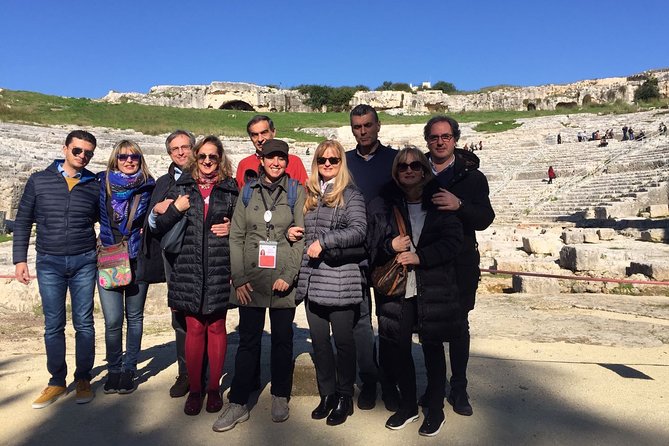
Stop 4 is the Roman amphitheater, Anfiteatro Romano di Siracusa, with 10 minutes. It’s called the fourth largest amphitheater in the world, and that size changes how you think about crowds. Roman amphitheaters weren’t just venues—they were engines for public spectacle, status, and spectacle-as-politics.
Even with a short time here, you can get a strong impression when the guide ties Roman building style to the earlier Greek context you already saw. Since this tour moves from Greek-era highlights into Roman monumental power, the amphitheater feels like the final chapter rather than a random extra stop.
You might also notice how the setting plays with memory. One review mentioned that the Roman theater and nearby areas are complemented by Mitoraj sculptures. Even if those sculptures aren’t the centerpiece of the stop, they can add a modern layer to a deeply ancient space—kind of like reading a footnote that changes how you see the whole page.
A 1.5-hour loop vs. a longer Neapolis stay
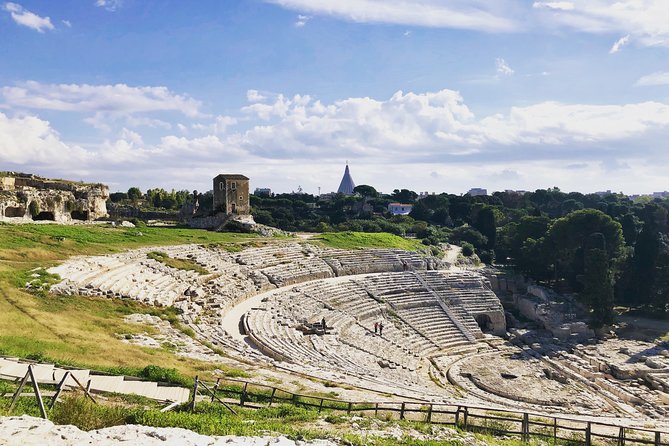
This tour is about 1 hour 30 minutes, give or take. That’s a smart length for most people with limited time in Syracuse. You’ll hit the major monuments without burning a half day commuting between them.
But it helps to know what Neapolis offers beyond this quick loop. Neapolis is an UNESCO-listed zone, and it rewards extra time if you enjoy wandering at your own pace. If you’re curious, you might look into areas like the Paradise quarry—described as a white limestone quarry with tunnels and caves where voices can echo in a way that surprises kids and adults alike. That’s not part of this short tour route, but it’s the kind of nearby add-on that makes a longer visit feel worthwhile.
So here’s the practical way to decide:
- If you want the highlights with a high-level explanation, book this.
- If you want to meander, read, and linger, plan more time at Neapolis and consider combining this with other self-guided exploring.
Small group comfort: how you’ll experience the tour day
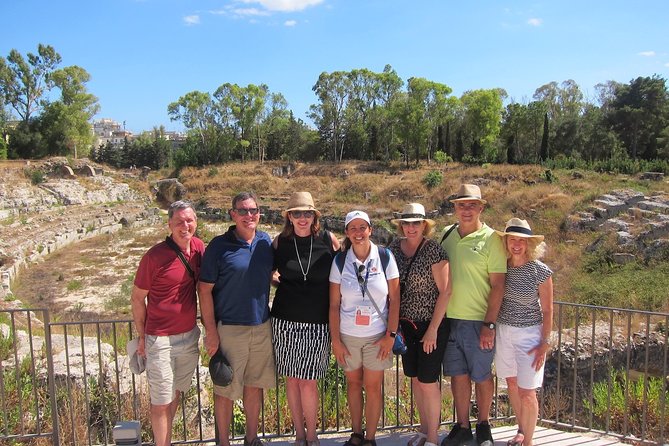
A maximum of 6 travelers changes everything about comfort. You’re less likely to feel rushed. You can ask follow-up questions when something clicks—like how Greek and Roman design principles show up in different places.
The tour is also described as requiring a moderate fitness level. That means you should expect walking through an outdoor archaeological park, with surfaces that may not be perfectly smooth. Plan for that with comfortable footwear and a water bottle.
Logistically, the meeting point is at Neapolis Archaeological Park, Via Luigi Bernabò Brea, 14, 96100 Siracusa SR, Italy. The tour ends back at the same meeting point, so you don’t need a separate plan for getting back.
Service animals are allowed, and the meeting area is near public transportation. That makes it easier to fit into a day that includes other Syracuse stops.
Who should book this Neapolis private tour
This is a strong fit if you:
- Want expert context from a PhD archaeologist, not just a general tour guide.
- Like small groups where your questions don’t get shoved to the end.
- Prefer a structured route that hits the biggest Neapolis monuments without guesswork.
- Want the chance to see the Ear of Dionysius, the Teatro Greco, the Ara di Ierone, and the Roman amphitheater in one compact outing.
It may be less ideal if you:
- Are trying to stretch a very limited budget and already know you’ll mostly rely on your own reading.
- Want to spend half your day in one place. This tour gives each monument a focused window, not a long, slow ramble.
For families, it can still work, but the key is that the group is small and the experience is structured. If you’re traveling with kids who love caves and echoes, Neapolis overall may impress—but this specific tour is tightly timed.
Should you book the Neapolis private tour with Enrica?
If your goal is to leave Syracuse feeling like you truly understand what you saw, I’d book it. The combination of a small group (max 6) and a PhD guide is exactly how you turn “I saw ruins” into “I get why these ruins matter.”
This also helps you make better use of your limited time. A 1.5-hour tour isn’t long, but it’s enough to cover the core monuments while you’re still fresh and before fatigue dulls your attention.
Just be honest about the math: you’ll pay the tour price, and you’ll also pay the €14 entrance fee. If that extra fee makes you pause, consider whether you’d rather self-guide. If you value interpretation and want help reading what you’re looking at—especially in places where inscriptions and details can be hard to see—then the cost starts to look more reasonable.
My simple rule: book this if you want meaning with your history. Skip it if you only want a photo stop.
FAQ
How long is the Syracuse Neapolis Archaeological Park private tour?
It’s about 1 hour 30 minutes.
Is the tour available in English?
Yes, the tour is offered in English.
What is included in the price?
The tour includes Dr. Enrica De Melio, PhD Archaeologist Guide and the private guided experience.
Do I need to pay an entrance fee?
Yes. The Biglietto d’ingresso all’Area Monumentale della Neapolis di Siracusa is €14.00 per person, and entrance fee is not included.
What group size should I expect?
The tour has a maximum of 6 travelers.
What happens if the weather is bad or I need to cancel?
The experience requires good weather. You can cancel for a full refund up to 24 hours in advance, and if it’s canceled due to poor weather, you’ll be offered a different date or a full refund.