REVIEW · PALERMO
Discover the Charm of Palermo: A 3-Hour UNESCO Sites Walking Tour
Book on Viator →Operated by Towns of Italy · Bookable on Viator
Palermo’s architecture moves at your walking pace. This 3-hour UNESCO-focused stroll strings together baroque and Norman-Arabic landmarks while your guide turns mosaics, power, and everyday street life into clear, practical context.
I especially like how the route pairs big sights with real neighborhoods—think Teatro Massimo’s grand square, then straight into open-air markets where you feel the city’s rhythm. The main drawback to plan around is pacing: it is a fast, highlights-first walk, and not every interior (like the Palatine Chapel) is listed as included, so you may want extra time if that is your top priority.
In This Review
- Key highlights you’ll feel fast
- Why This Palermo UNESCO Walk Works in 3 Hours
- Meeting the City at Teatro Massimo and Via Maqueda
- San Domenico, Piazza Caracciolo, and the Mafia-Symbol Church
- Stock Exchange History and the Descent of the Judges
- La Martorana (Santa Maria dell’Ammiraglio) and Palermo’s Greek-Byzantine Layer
- Piazza Pretoria and Quattro Canti: Palermo’s Perfect Intersections
- Inside Palermo Cathedral: Where Styles Stack Up
- Villa Bonanno and the Palace of the Normans: The Palatine Chapel Context
- Food at the End: Cannolo or Granita, Done Right
- Pace, Listening, and Group Size: How It Feels on Your Feet
- Who This Tour Fits Best (and Who Might Want More Time)
- Price and Value for $31.88: What You Actually Get
- Should You Book This Palermo UNESCO Walking Tour?
- FAQ
- How long is the Palermo UNESCO sites walking tour?
- What does the tour cost?
- Is the tour offered in English?
- What’s included in the price?
- Do we enter the Palermo Cathedral?
- What is the maximum group size?
- Where do we meet, and where does the tour end?
- Does it run in bad weather, and is cancellation free?
- Are pets allowed on the tour?
Key highlights you’ll feel fast
- UNESCO-linked architecture with explanations that stick: You connect Norman, Arab, and later styles in plain language.
- Palermo Cathedral entry is included: You do more than just look from the outside.
- Street-level stops are built in: Markets and fountains matter here, not just palaces.
- Small groups (max 20): Easier questions, easier listening, less crowd pressure.
- A real food finish: Typical Sicilian cannolo or granita at the end.
- Live local storytelling from guides: Names like Valeria, Fabio, Renata, and Simone come up again and again for a reason.
Why This Palermo UNESCO Walk Works in 3 Hours
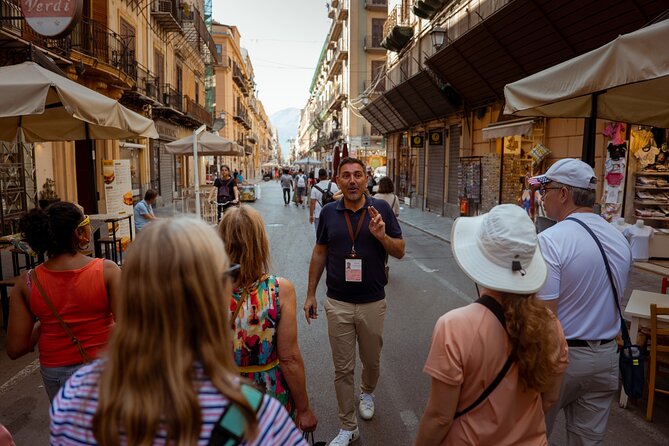
Palermo can feel like a lot on day one. Cars, scooters, loud market stalls, and historic buildings stacked over centuries all at once. This tour helps you get your bearings fast by organizing the city around a simple idea: architecture plus street life equals understanding.
At $31.88 per person for about 3 hours, it is also a smart value if you want structured time. You get a licensed English-speaking guide, a mobile ticket, and a mix of quick stops that would take you much longer to stitch together on your own.
The best part is how your guide frames what you’re seeing. Instead of separate facts, you get cause-and-effect: who built what, why styles changed, and how Palermo’s mix of cultures still shows up in details you’d miss solo.
You can also read our reviews of more walking tours in Palermo
Meeting the City at Teatro Massimo and Via Maqueda
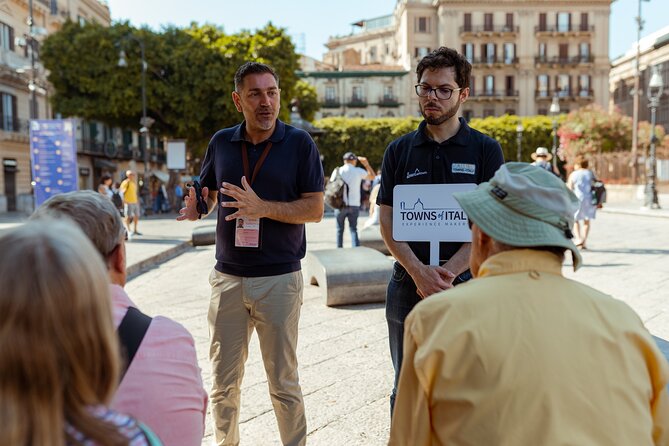
The walk starts at Via Volturno, 44, then moves quickly into Palermo’s central spine. Your first stop is the Teatro Massimo Vittorio Emanuele, the big opera house on Piazza Verdi.
Even if you never catch a show, it’s worth meeting this building at the beginning. Teatro Massimo is known for its excellent acoustics, and it is also tied to national identity because it was dedicated to King Victor Emanuel II. It’s one of those landmarks that signals Palermo’s ambitions, not just its age.
From there, you head toward the Galleria delle Vittorie on Via Maqueda. The structure began life as a commercial mall, and over time it deteriorated, with restoration attempted. That half-glam, half-worn look is very Palermo: history doesn’t sit still like a museum piece.
Then you cross via Bandiera, where you’ll see a typical open-air market vibe. This matters because Palermo’s atmosphere is not limited to monuments. You’re training your eyes to notice both the grand facades and the everyday commerce happening right beside them.
San Domenico, Piazza Caracciolo, and the Mafia-Symbol Church
Next comes Chiesa di San Domenico, in a square that visually dominates the area—right after the Cathedral in terms of importance. It’s a beloved Palermo church for a few reasons: it’s described as a Pantheon of the illustrious men of Sicily, and it carries symbolism tied to the city’s fight against the mafia.
If you only know Palermo from headlines, this is the kind of stop that reframes the story. You’re seeing how public buildings can represent resistance and identity, not just faith.
After that, the route threads through Piazza Caracciolo and adjacent lanes—market energy built right into the walk. You’ll hear how the market was once called la Bucceria, linked to the idea of butcher shops. Even if you don’t buy anything, it gives you a sense of why locals keep coming back to these streets for daily staples.
You also get the Garraffo Fountain in Piazza Marina, down the ancient Cassaro street (now called Via Vittorio Emanuele). It’s Baroque, and it’s placed where it belongs: in the historic flow of pedestrian movement, not isolated on a postcard corner.
Stock Exchange History and the Descent of the Judges
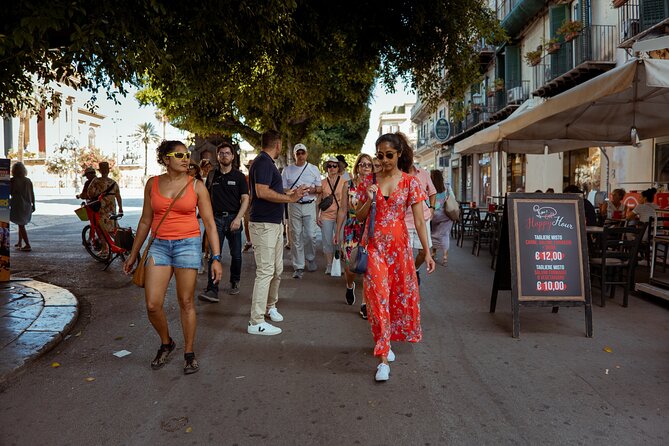
A clever part of this tour is that it doesn’t treat “history” like only churches and palaces. You also cover the city’s civic and economic story—starting with the Palermo Stock Exchange.
You’ll learn that it functioned until 1997, when institutions were unified, and that trading began earlier in the city’s story of finance. The key takeaway is how Palermo built formal economic life—then shifted over time.
Then you move to the descent of the Judges (calata dei giudici), running between Piazza Sant’Anna and Piazza Bellini. This street takes its name from the Judges of the Praetorian Court who lived in the monastery of S. Caterina. Even in a narrow street like this, the city leaves labels tied to governance, justice, and power.
For me, stops like this are what make a short tour feel complete. You start to see Palermo as a system, not just a backdrop.
La Martorana (Santa Maria dell’Ammiraglio) and Palermo’s Greek-Byzantine Layer
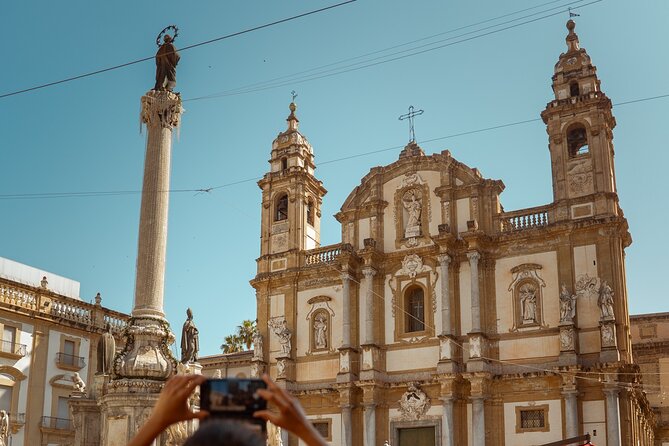
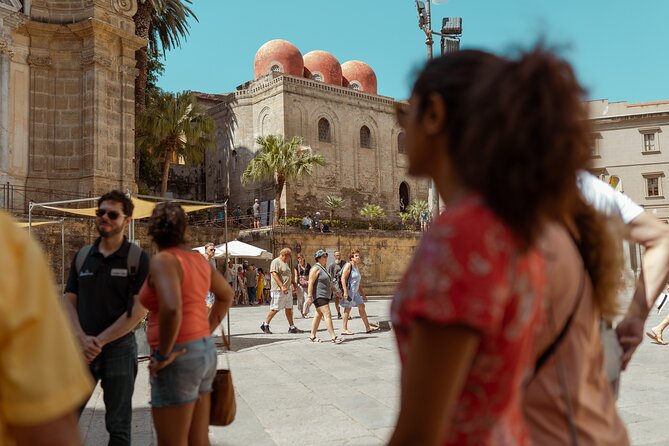
One of the most memorable switches in architectural culture comes at Santa Maria dell’Ammiraglio, also called La Martorana. It’s located over piazza Bellini, and it’s tied to the nearby Benedictine convent founders.
The standout detail here is the mix of languages and clergy. The church was built in 1143–1185 by Greek admiral George of Antioch, and it was assigned to Greek-Byzantine clergy. The ceremonies are described as being in ancient Greek or Albanian, and the church belongs to the Eparchy of Piana degli Albanesi.
What you’re really absorbing is how Palermo’s cultural blend wasn’t theoretical. It shaped who served inside the church and what language lived in the rituals.
This is also a great moment to slow down visually. If you’re the kind of traveler who likes to spot patterns, you’ll start connecting earlier stops to later ones—especially the Norman-Arabic thread that keeps reappearing.
You can also read our reviews of more tours and experiences in Palermo
Piazza Pretoria and Quattro Canti: Palermo’s Perfect Intersections
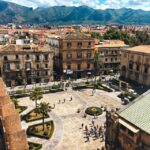
Then you hit Piazza Pretoria, near Kalsa, close to where the four quarters meet. The fountain here has a backstory that surprises people: it was created for a garden of don Luigi de Toledo in Florence, then later relocated and adapted.
The plot of the piazza in Palermo began as a garden connected to nuns of San Domenico al Maglio, and you’ll hear how it was obtained in 1551. The Palazzo di San Clemente appears nearby as development continued in 1584, and the fountain was commissioned to Florentine sculptor Francesco Camilliani, linked to the orbit of Baccio Bandinelli.
Next is Quattro Canti, also known as Piazza Vigliena. This is one of Palermo’s most popular spots for a reason. Four buildings outline the square, built between 1608 and 1620, while the decorative elements were completed later in 1663.
If you want a practical payoff: Quattro Canti works like a landmark compass. It’s described as an ideal starting point for exploring Palermo’s city center, because everything radiates out from this intersection of historic quarters.
Inside Palermo Cathedral: Where Styles Stack Up
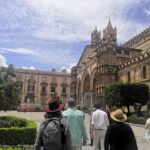
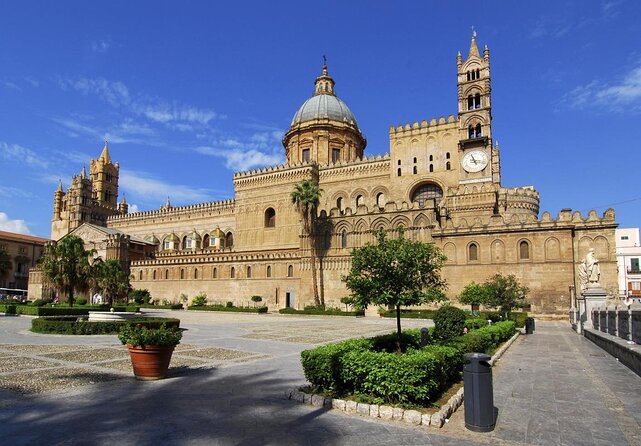
The tour includes entrance to Cattedrale di Palermo. This is the one “inside” stop you’re guaranteed, and it’s a big deal.
The Cathedral was built in 1184 by the Normans as a reconverted Christian church on the site of a Muslim mosque, which had been built over an earlier Christian basilica. That layering is not abstract. When you stand in the Cathedral space, you’re seeing how each era rewrote what came before.
You’ll also hear that the Normans built with competition in mind, aiming to surpass the beauty of Monreale. That helps explain why the building reads as ambitious from multiple angles.
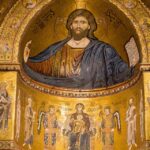
What makes it especially worth your time is the stratification of styles: Gothic to Medieval, Arabic, and later Neoclassical elements. There’s even mention of an actual engraving of an Arabic passage from the Koran on a column. In other words, this is not just “inspired by” influences—it keeps traces of them.
Plan for about 30 minutes here. You’ll want enough time to look up and take in details without feeling rushed.
Villa Bonanno and the Palace of the Normans: The Palatine Chapel Context
After the Cathedral, you shift toward quieter, greener history at Villa Bonanno. Built in 1905 by Mayor Bonanno, it’s a garden always open behind the Palace of the Normans in Victory Square.
This stop is practical because it gives your feet a break. You’ll see palm trees, statues, and busts of famous Palermo figures. There are also remains of Roman patrician houses with mosaics, including mosaics of the seasons and Orpheus, with the note that these are now kept in the National Archaeological Museum.
Adjacent is a fountain with a monument connected to Philip V. The description includes that it was made in the nineteenth century by Nuncio Morello, and it’s also described as seeming to connect to an earlier design attributed to Carlo d’Aprile with participation of Serpotta. That kind of layered attribution is common in historic monuments, so don’t stress about pinning down every date—focus on what the garden represents: Palermo’s long timeline of power and art.
Then comes Palazzo dei Normanni, the Royal Palace. It’s framed as a history book in stone, tracing Palermo from early Punic settlements through later eras. The connection to UNESCO is tied to the Cappella Palatina (Palatine Chapel), described as a manifesto of Arab-Norman art and a World Heritage Site since 2015.
One important practical note: Palatine Chapel entry is not listed as included for this specific tour format. You should expect context, architectural storytelling, and palace-area access, but if you want maximum time inside the Chapel itself, treat this stop as a foundation rather than the whole meal.
Food at the End: Cannolo or Granita, Done Right
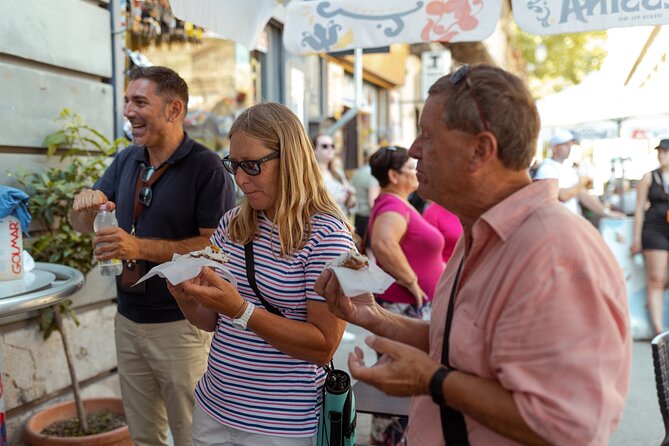
The tour includes a typical Sicilian sweet: cannolo or granita. The best tours time food so it feels like a reward, not a distraction.
Here, it works because you’ve just spent hours training your eyes on architecture and street history. A cannolo or a lemon granita gives you a sensory reset and a quick taste of what you’ll want to chase again later.
If you’re the type who likes to plan ahead: build your next meal around what you discover near Piazza Caracciolo and the nearby lanes. The city tends to reward curiosity, and this tour gives you the right spots to return to.
Pace, Listening, and Group Size: How It Feels on Your Feet
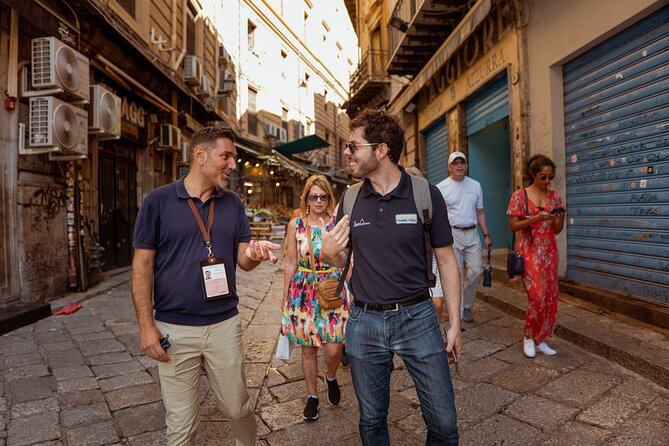
This is a walking tour, designed for about 3 hours, with a maximum of 20 travelers. That small size is a big deal in Palermo, where the streets can get tight fast.
Many guides also use an amplification system, which helps when you’re standing near traffic or in louder market pockets. It’s worth it—because when you hear the guide clearly, the facts turn into understanding instead of background noise.
The pacing is quick enough that you’ll cover a lot, but not so frantic that it feels like a race. Still, it’s not a slow museum crawl. If you’re a slow walker or you stop for photos constantly, plan for a bit of “less time inside” at the most detailed sites.
One more practical thing: Palermo is active. Expect people and vehicles in the same lanes. Keep your head up, wear comfortable shoes, and treat the walk like a city walk, not a scenic trail.
Who This Tour Fits Best (and Who Might Want More Time)
I’d steer you toward this tour if:
- you want a high-impact introduction to Palermo’s UNESCO-linked places
- you like learning how cultures mix through architecture
- you want a structured plan that still leaves room to wander after
It’s also a great first-day pick because you’ll finish with a sense of where to head next—especially around the Cathedral area and the major crossroads near Quattro Canti.
You might want to pair it with additional time (or a second tour) if:
- the Palatine Chapel mosaics are your number one goal, since the tour format emphasizes context and not guaranteed interior time
- you prefer longer stops inside major buildings
Price and Value for $31.88: What You Actually Get
For $31.88, you’re paying for three things: a guide, entry to the Cathedral, and a food stop.
The Cathedral admission is the clearest “cash value” item, and it matters because you don’t want to arrive at a big church without the context. Add in the licensed English guide and the fact that many other stops are outside but packed with stories, and the price starts to feel reasonable.
You also get a mobile ticket, which reduces friction on meeting day. And since the tour runs regardless of weather, it helps you protect one of your few good sightseeing windows.
Should You Book This Palermo UNESCO Walking Tour?
I think you should book it if you want a smart, short introduction that connects Palermo’s Norman-Arabic style to real streets, real markets, and real city life. This is the kind of tour that makes your next walks easier because you understand the “why” behind what you’re seeing.
Skip it or plan extra time if you specifically want multiple interiors and long museum-style viewing. This tour is built to show you the big picture in about 3 hours, not to replace a longer, site-by-site deep visit.
If you can only spare one morning or afternoon for Palermo highlights, this is one of the best ways to spend it.
FAQ
How long is the Palermo UNESCO sites walking tour?
It lasts about 3 hours.
What does the tour cost?
The price is $31.88 per person.
Is the tour offered in English?
Yes. The tour is offered in English, with a licensed English-speaking guide.
What’s included in the price?
You get a licensed English guide, a walking tour with city monuments (seen from outside), entrance to Palermo Cathedral, and a typical Sicilian cannolo or granita. There’s also a mobile ticket.
Do we enter the Palermo Cathedral?
Yes. Entrance to the Cathedral is included.
What is the maximum group size?
The tour has a maximum of 20 travelers.
Where do we meet, and where does the tour end?
You meet at Via Volturno, 44, 90138 Palermo PA, Italy, and the tour ends back at the meeting point.
Does it run in bad weather, and is cancellation free?
The tour takes place regardless of the weather. Cancellation is free if you cancel at least 24 hours in advance for a full refund.
Are pets allowed on the tour?
No, pets are not permitted. Service animals are allowed.