REVIEW · SICILY
Catania, a baroque jewel – Tour For All Ages – Certified Guide
Book on Viator →Operated by Sonia Arena · Bookable on Viator
Baroque Catania hits fast. This walking tour helps you get your bearings with a guided loop that mixes grand squares, baroque churches, and even stories tied to the city’s underground world, without you wrestling a map. I really like how it’s built for short time windows while still showing you the real Catania vibe—loud, human, and full of layers.
My favorite part is the way the guide connects local legend and major historical turning points. Sonia Arena brings the city’s famous stories to life—like the Gammazita Well legend—and ties the architecture to what Catania went through, including the 17th-century volcanic eruption. It turns pretty buildings into something you can actually remember.
One drawback to plan around: the walk is tight and some stops are best enjoyed from the outside (like Palazzo Biscari), plus bottled water and snacks aren’t provided, so you’ll want to pace yourself.
In This Review
- Key highlights worth showing up for
- Catania’s baroque, in a walk-sized dose
- Starting at Piazza del Duomo: where the whole story begins
- Chiesa della Badia di Sant’Agata: the facade and dome moment
- Via dei Crociferi: baroque street with legends baked in
- Palazzo Biscari: seeing the exterior without the waiting game
- Archi della Marina and the lemon squeeze break
- The big themes: eruption, Roman layers, and underground Catania
- Why 2 hours is the sweet spot for first-timers
- Timing, meeting point, and where the tour naturally ends
- What you get for your money (and what to bring)
- Who this walking tour fits best
- Should you book this Catania baroque highlights tour?
- FAQ
- FAQ
- How long is the Catania walking tour?
- What is the price per person?
- Where does the tour start and end?
- Is the tour private or group-based?
- What’s included in the tour?
- What isn’t included?
- Are there any free admission stops during the walk?
- Can I bring a service animal?
- What is the cancellation policy?
Key highlights worth showing up for
- A certified guide named Sonia Arena keeps the stories clear and the facts tied to what you’re seeing
- Baroque focus in just ~2 hours, so first-timers can see a lot without committing to a full day
- Legends like the Gammazita Well give the city personality, not just architecture trivia
- Ancient Roman layers and underground elements show Catania isn’t only about what’s above street level
- A classic Sicilian lemon squeeze stop breaks up the walk in a very practical way
- Private-experience flexibility means your group can set the pace instead of being rushed by a rigid script
Catania’s baroque, in a walk-sized dose
Catania can feel like two cities at once. You get the baroque drama—curving facades, ornate stonework, dramatic domes—then you hit the real street energy: scooters threading by, shops pulling focus, and the city asking for your attention every ten seconds.
That’s exactly why this kind of guided loop works. You’re not trying to decode a self-guided trail while you’re still adjusting to traffic noise, sun angles, and Italian street layouts. Instead, your guide points out what to look for, explains why it’s there, and keeps you moving at a pace that fits the group.
And yes, you do get the wow factor, but not in a museum-only way. This is about understanding how Catania’s identity formed across eras: Roman foundations, baroque rebuilding, and major events like the 17th-century volcanic eruption that shaped what the city became.
You can also read our reviews of more guided tours in Sicily


Starting at Piazza del Duomo: where the whole story begins
Most Catania “first stop” moments are about orientation. This one is different. Piazza del Duomo isn’t just a pretty square; it’s the emotional center of the baroque city plan. In a short stop, you’re set up to understand the rest of the walk.
Here, you’ll look at the main buildings around the square—the Cathedral, the Town Hall, and the Archbishopric—and learn how they relate to Catania’s role as a cultural and religious hub. The guide’s job is to make the architecture feel legible: what to notice first, what details are symbolic, and how the baroque style functions as a kind of public storytelling.
A practical tip: arrive mentally ready to glance up. Catania rewards upward looking. Stone details, cornices, and facade rhythm aren’t just decoration; they’re part of how the buildings communicate power and identity.
Chiesa della Badia di Sant’Agata: the facade and dome moment
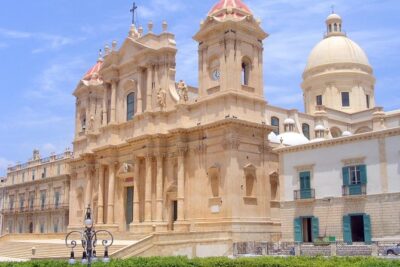
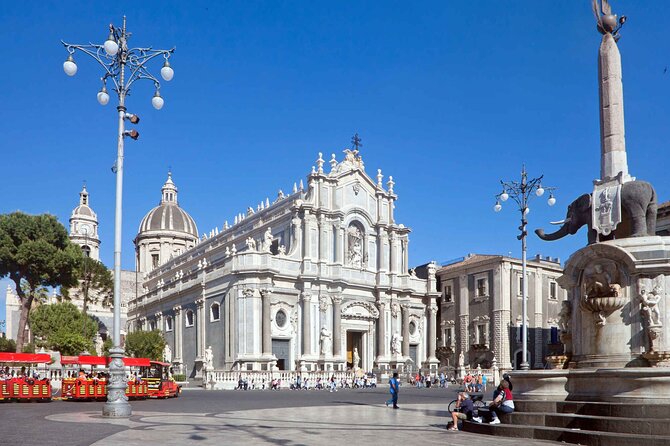
If you only see one church on your first visit, make it this one. Chiesa della Badia di Sant’Agata is a signature baroque monument, and even with a quick stop, there’s enough here to feel like a real highlight.
The facade uses patterns with concave and convex lines, so the front doesn’t sit flat—it shifts visually as you move. That’s very baroque: it’s architecture that plays with your position. Then there’s the octagonal dome, which dominates the building and helps explain why Catania’s skyline looks the way it does.
In a short 10-minute window, you won’t memorize every feature, but you’ll know what you’re seeing. You’ll also walk away with a clearer sense of why baroque church design wasn’t only for worship. It was for spectacle—proof of wealth, faith, and resilience after major disruption.
Via dei Crociferi: baroque street with legends baked in
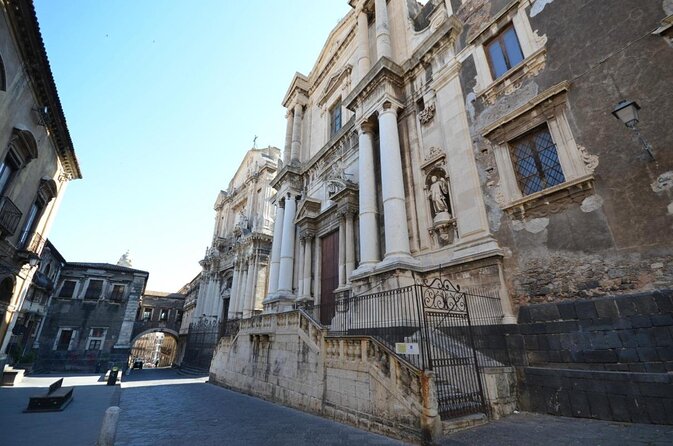
One of the best things about this experience is that it doesn’t treat architecture like a photo backdrop. Via dei Crociferi is genuinely one of Catania’s most picturesque baroque streets, full of churches and stories.
During this segment, you’ll hear legends and local lore connected to what you see along the way. This is also where the guide’s narration matters. If you walked this street alone, you might spot beautiful facades and keep moving. With a guide, the street starts to feel like a timeline you can walk.
Two small benefits you’ll feel immediately:
- You’ll know what to look for besides the obvious ornament.
- You’ll stop seeing it as “more churches” and start seeing it as a connected whole.
Just keep your eyes open for the street’s rhythm. It’s not a quiet lane; it’s a living corridor. That’s part of the charm, and it means you’ll want comfortable shoes.
Palazzo Biscari: seeing the exterior without the waiting game
Palazzo Biscari is the kind of baroque private building you expect in an old aristocratic city—grand, imposing, and made to impress. The good news: you get to admire it without being trapped in a long indoor visit.
The catch is also simple: the stop focuses on the exterior. If you love interiors, you may end up wanting more. But as part of a 2-hour overview, this works. It gives you the palace presence and the baroque scale, then sends you onward so the day stays efficient.
Also note this: admission for this stop isn’t included. So if you want to go deeper later, plan to treat Palazzo Biscari as a separate interest you can add on with your own time.






Archi della Marina and the lemon squeeze break
By the time you reach Archi della Marina, you’re past the big visual hits and ready for something practical. This stop includes a typical Sicilian lemon squeeze—quick, refreshing, and very on-theme for a city that treats simple street food as a ritual.
The lemon squeeze isn’t just a snack substitute. It’s a pacing tool. In warm weather, a short break like this can keep the whole walk enjoyable rather than turning it into a sweaty speedrun.
If you’re the type who likes food moments that feel local (not “themed”), this one delivers. It’s small, but it’s also the kind of stop you’ll remember because it’s sensory. The taste is tied to the place, not to a restaurant name.
The big themes: eruption, Roman layers, and underground Catania
This tour is designed to connect physical sites to bigger forces. You’ll hear about Catania’s ancient past, including Roman ruins, and you’ll also learn about an underground river element that helps explain how the city works beneath your feet.
Then comes the 17th-century volcanic eruption. This is where Catania’s personality becomes impossible to ignore. The city’s baroque look wasn’t created in a vacuum; it’s tied to rebuilding and survival. Your guide’s job is to translate that into something you can picture while you stand in the sun looking at stone that still carries the scars and the solutions.
One of the most memorable story threads is the Gammazita Well legend. It’s the kind of tale that makes the city feel lived-in, because it shows how people explained their world long before signage and maps. Even if you’re not a “legend person,” you’ll still appreciate the way these stories make Catania feel human.
Why 2 hours is the sweet spot for first-timers
If you’re visiting for a day—or you want an efficient morning or early afternoon activity—this duration makes sense. A long tour can be exhausting in Sicily. A short one can feel incomplete. Two hours hits a middle ground: enough time to see meaningful pieces, without draining you before you explore on your own.
You’ll also benefit from the pacing. The experience is private for your group, and your guide can adjust the itinerary and tempo. That matters if:
- your group prefers a slower photo break,
- you’re traveling with older folks,
- or you simply want more story time at the places that grab you.
And because it’s walking, it’s the kind of experience that fits your schedule better than a bus ride. You stay close to where the city is actually happening.
Timing, meeting point, and where the tour naturally ends
You start in Piazza del Duomo, 95100 Catania CT, Italy. That’s a smart choice because it puts you right at the main hub. You don’t have to cross town first just to begin seeing the best of baroque Catania.
The tour ends at Palazzo Biscari, via Museo Biscari, 10, 95131 Catania CT, Italy, which is useful because the area is ideal for continuing your visit. The idea here is simple: you finish near a place where you can keep exploring without returning to the Duomo zone.
If you’re planning a meal afterward, keep it flexible. Sicily tends to be best when you follow the moment—especially after you learn the stories behind the streets you’re about to wander.
What you get for your money (and what to bring)
The price is $52.04 per person for about 2 hours. For a guided overview that includes a snack-like local stop (lemon squeeze), professional storytelling, and multiple major highlights, it’s a fair value—especially when you consider how expensive your time is on a first visit.
Still, go in knowing what isn’t covered. Bottled water and snacks aren’t included, and you may want to budget for any optional admission costs at stops that charge separately. Even if you don’t need food, bringing a small bottle can help you stay comfortable, especially in hotter months.
One more thing: the experience includes gratuities. That removes a common headache, since you can focus on enjoying the walk instead of doing last-minute math.
Who this walking tour fits best
This experience is listed for all ages, and “most travelers can participate,” which is a good sign for a fairly straightforward walking format. It’s also a smart fit if:
- you’re in Catania for a short time and want highlights with context,
- you like your architecture tours to include stories and legends,
- you want Roman and underground themes without committing to a longer deep-dive day,
- or you want a guide who can tailor pacing for your group.
It’s also a solid choice if you enjoy food-and-history moments. The lemon squeeze stop ties the sightseeing to everyday local life, not just landmark photos.
If you’re the kind of traveler who hates groups or wants total freedom, you might prefer a self-guided plan. But if you want a guided route that helps you avoid the “where do I even start?” problem, this is built for that.
Should you book this Catania baroque highlights tour?
Yes—if you want a smart, story-driven overview that helps you understand Catania quickly. You’ll get a concentrated look at Piazza del Duomo, Chiesa della Badia di Sant’Agata, Via dei Crociferi, a strong exterior moment at Palazzo Biscari, and a very local break with the lemon squeeze. On top of that, the guide work connects the city’s visible beauty to the upheavals behind it, including the 17th-century eruption and older Roman layers.
Book it especially if:
- you’re short on time,
- you’re traveling with mixed ages,
- or you want the Gammazita Well legend and underground themes explained in plain language.
Skip it if your main goal is museum-style interior access everywhere, because at least one major highlight is treated as an exterior admiration stop and extra admissions may be on you.
FAQ
FAQ
How long is the Catania walking tour?
It runs for about 2 hours.
What is the price per person?
The price is $52.04 per person.
Where does the tour start and end?
It starts at Piazza del Duomo, 95100 Catania CT, Italy and ends at Palazzo Biscari, via Museo Biscari, 10, 95131 Catania CT, Italy.
Is the tour private or group-based?
It’s a private experience—only your group participates.
What’s included in the tour?
Gratuities are included. You also get a mobile ticket.
What isn’t included?
Bottled water and snacks aren’t included. Also, admission at Palazzo Biscari is not included.
Are there any free admission stops during the walk?
The stops at Piazza del Duomo, Chiesa della Badia di Sant’Agata, Via dei Crociferi, and Archi della Marina are listed as free.
Can I bring a service animal?
Service animals are allowed.
What is the cancellation policy?
You can cancel for a full refund up to 24 hours before the experience’s start time. Cancellation within 24 hours isn’t refundable.